Educational activities were halted once again in Gaza due to Israeli airstrikes, impacting over 40 thousand children and 51 educational institutions, in a single week in May. Schools in the region remained closed, forcing thousands of displaced people to use the buildings as temporary shelters.
“Some of the main barriers to education are attacks on schools and on the way to school, damage to education infrastructure, and the psychological trauma that children, parents, and teachers face daily,” explains Raffoul Saadeh, Executive Director of Tomorrow’s Youth Organization, a partner of Qatar Fund in supporting educational activities in Palestine. “The poor quality of education leads to an increase in school dropouts, as well as a significant increase in severe adversity and trauma in children, parents, and teachers.”
Through partnering with Tomorrow’s Youth Organization (TYO) in 2017, Qatar Fund supports 11,500 women, children, and youth in Palestine by investing in programs for education, health, and economic development. The partnership aims at keeping children in school, providing career opportunities, and access to higher education.
The organization does not limit itself to the classroom. Instead, it provides a combination of education services, remedial education programs, mental health and psychosocial services, and recreational activities to ensure that students remain in school till they graduate.
And that’s a wrap! Thanks for celebrating with us this #PalestineDay and supporting our amazing community here in #Nablus. And a big thank you to our friends at @qatar_fund #QFFD, your support of #TYO and the #Palestinian people means the world to us. pic.twitter.com/eMhU3zi15d
— Tomorrow’s Youth Organization (@tomorrowsyouth) November 29, 2019The Youth Entrepreneurship program is one such program that enables 20 to 35-year-olds to build valuable industry connections, receive training sessions to develop and realizetheir ideas, and raise seed-funding for start-ups. Raghad Junaidi, a female Palestinian entrepreneur, participated in the program to create Story Out, a virtual tourist guide.
“I want to promote tourism in Palestine; to make it a popular destination for international tourists,” says Junaidi. “I describe ‘Story Out’ as the place that brings together several tourist services at the same time.”
Her other projects include an application that connects parents with their children in kindergartens. For Junaidi, the hardest part of running a business is being able to constantly innovate to meet the demand of consumers. The program provided her with essential business skills while connecting her with established business owners and entrepreneurs.
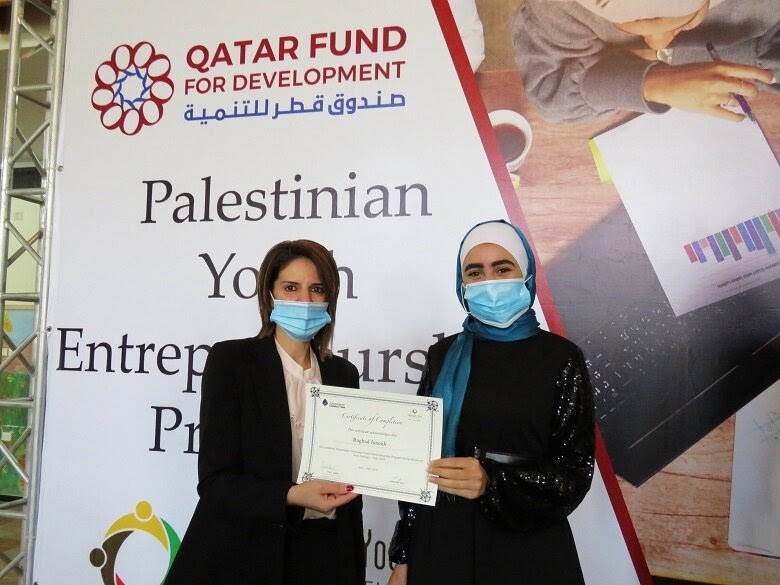
Junaidi advises Palestinian students to work towards developing their entrepreneurial skills to provide others with employment and achieve financial independence. “Palestine is filled with creative youth entrepreneurs who are full of bright ideas,” she adds. “The entrepreneurship world is definitely waiting for them to shine.”
In just the span of a few years, the partner organizations have worked with 8478 beneficiaries in various programs ranging from education and employment training to mental health and women empowerment projects. “Today, the Qatar Fund and TYO partnership is a leading force for good in Palestine as we have built trust and achieved lasting impact,” says Saadeh.
Wajd is another program supported by the fund that has provided orphans in Gaza with education and healthcare support since 2014. The program is run in partnership with Taawon Welfare Association and has set up businesses, provided job training sessions, and helped students pursue higher education.
“It is a great partnership that has left a significant impact on 2157 orphans and 642 families,” says Maha Muhaisen, a program manager at Taawon. “We hope that it continues till the orphans become self-reliant.”
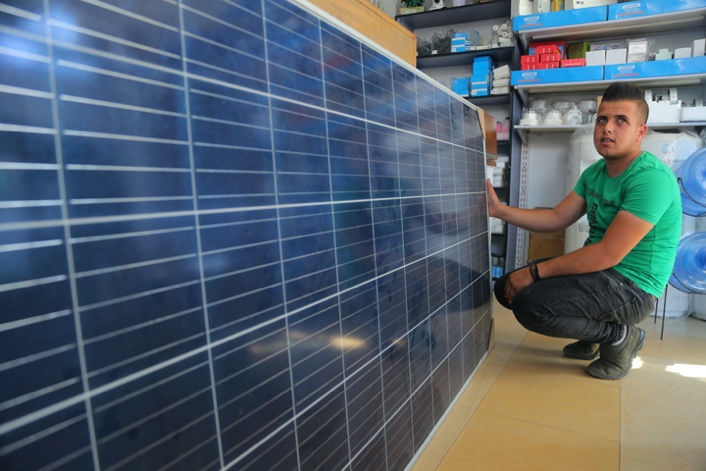
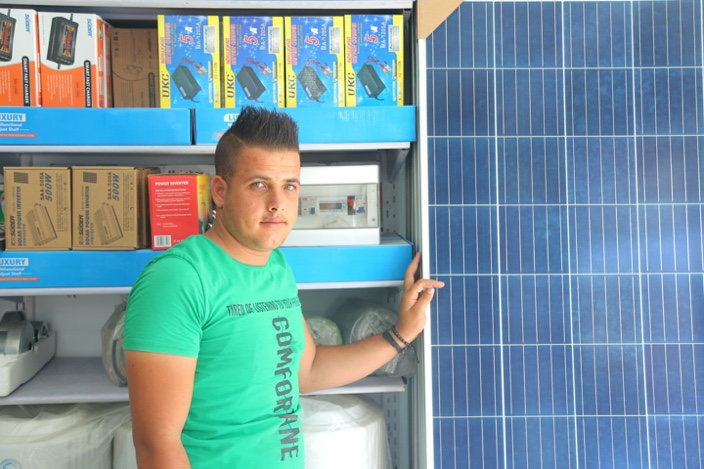
With the help of the Wajd program, 22-year-old Mohammad Abdeen from Gaza opened his own business, selling and installing solar panels after he was orphaned along with his eight younger sisters in the 2014 assault of Gaza. The program offered him a diploma and vocational training in solar energy systems. Hospitals, homeowners, and farmers now rely on electricity supplied by Abdeen’s solar panels.
Electricity is expensive and scarce in Gaza. Farmers relying on irrigation need electricity from the grid to pump water to the crops. Abdeen and his team replace this with a system that essentially provides farmers free, off-grid and environmentally friendly electricity. Customers who cannot pay the full amount can finance the system through installment plans.
Abdeen recalls a small business owner who sold frozen-foods and had a problem with increasing electricity costs and outages. The owner lacked the funds to install the solar power system, so Abdeen provided a weekly installments option for him. “Refrigerators are the backbone of a frozen-foods business,” notes Abdeen. “The solar panels have significantly improved the business and its owner’s life.”
Abdeen is now the sole breadwinner for his mother and sisters. “I can now work with complete independence and provide for my family’s needs from my own hard work,” he says. “I would like to thank the key donor, the Qatar Fund, and all other Wajd supporters that helped us achieve this success.”
Last year, 920 students of Birzeit University in the West Bank were given scholarships through the Fund, with an additional $2.5 million allocated to improve the university infrastructure. These and other Qatar Fund programs support the fourth UN Sustainable Development Goal of providing quality education and lifelong learning opportunities for the people of Palestine.

 Abdullah Imran Tahir